← pablin.me

Artillery, on iPhone

Fire one long.
Fire one short.

Bracketing is how artillery actually finds a target: one over, one under, then halve the difference. Bracket is a two-tank duel built around making that possible — and around refusing to do it for you.

iPhone iOS 17 No ads, no purchases

Coming to the App Store.

No accounts, no analytics, and no network calls of its own
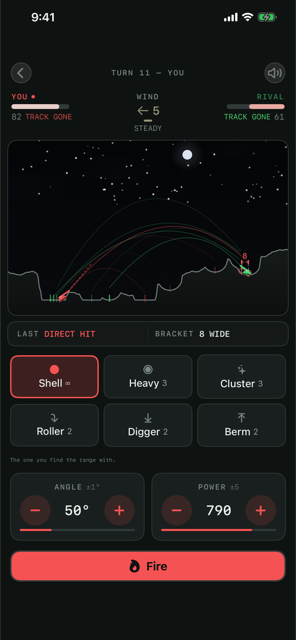
A match in progress: several arcs over a hill, a bracket drawn on the ground at the far tank's feet with 8 written between its ends, and the last shot called a direct hit
BRACKET 8 WIDE — AND THE SHOT THAT CLOSED IT
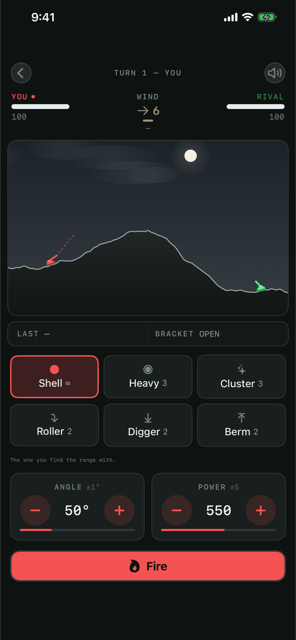
The opening of a match: a generated hill between the two tanks, the wind gauge above and the six shells below
THE FIELD
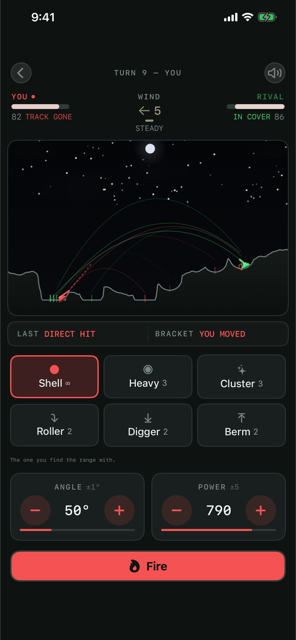
The far tank hit and in cover, its health down, with every earlier arc still faintly on screen
A DIRECT HIT
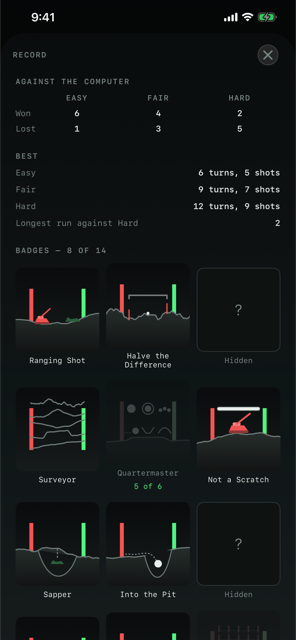
The record screen: matches won and lost against each opponent, personal bests, and the fourteen badges with the unearned ones dimmed
YOUR RECORD

The name is the method

Every decision follows from one idea

Fire one long, fire one short, halve the difference. Everything in the game exists to make that possible, and nothing in it exists to do it for you.

I

The dials keep their numbers

Your last shot is what you adjust from, so the angle and the power are still there when your turn comes round. A game that reset them would be guesswork with extra steps.

II

Drag to point, step to close

A drag gets you roughly there in one gesture. Closing a bracket means moving the power by five, which no finger can place — so there are steppers over the same two numbers, and they tell you what one press is worth.

III

Every shot is called

42 OVER. 18 SHORT. In world units, signed, measured against where the other tank was standing when you fired — the way a spotter calls it, because a call is a statement about a moment.

IV

A bracket is drawn as a bracket

Land one long and one short and the game joins the two falls, with the span between them written on it. Then it is arithmetic, which is the point.

V

Nothing aims for you

No aiming line, no landing marker, no suggested power. Turning your two shots into the answer is one line of code and it is deliberately not there.

VI

The ground is half the opponent

Craters take material away, berms put it back, and tanks slide when the ground under them gets too steep to hold. A near miss can take somebody's footing — and their bracket with it.
Three opponents

Difficulty is method, not a handicap

None of them is given anything you are not. What changes between them is how they think about the shot.

Easy

One coarse sweep for a rough answer, never refined, with a beginner's hands on the dials.

Fair

Looks only at what a person could see: the shots it has fired, how far away you are, and the wind gauge. It opens on an estimate, keeps its angle, moves its power, and interpolates once it has one long and one short.

Hard

Solves the arc properly every turn, over a fan of angles, wind and craters included. Of the shots it aims at a tank, 97% land within a hull's width first time.

Ways to play

Five, and one of them needs no signal

Game Center carries the leaderboards, the badges and matches against other people. Everything else works signed out, on a train.

I

Today's field

One landscape, one wind, the same on every phone in the world, changing at midnight UTC. One attempt, and it is spent the moment the match begins rather than when it ends.

II

Two players, one phone

Hand it back and forth. Nothing is earned this way, because a leaderboard a second thumb can fill is not a leaderboard.

III

A turn at a time

Turn-based matches through Game Center, with a notification when it is your move. What travels between the two phones is a seed and a list of shots, and nothing else.

IV

Practice on ground you chose

Any shape, any wind, so you can learn a mesa rather than meet one once in fifteen matches. It earns nothing, which is what makes it practice.

V

Send a whole duel as a link

A match of ordinary length is about a hundred and fifty characters, so there is nothing to fetch at the other end. Open one and it plays out from the first shot.

Signing in to Game Center puts your results on the boards and shows the name on your Apple Account to the person you are playing. Only matches against the computer post a score. See the Privacy Policy for what that means in practice.

Nothing to collect, by construction

No accounts of ours, no analytics, no advertising, no third-party SDKs, and no networking code in the app at all. Your record stays in the game's own preferences on your device. The one thing that leaves is a Game Center match, which is a seed and a list of shots and travels through Apple.

Read the full Privacy Policy