← pablin.me

Watch repair, on iPhone and iPad

Open it.
Mend it. Hear it run.

You inherit the shut watch shop of Tomás Arroyo in Quito's old town, and with it a drawer of twelve repairs nobody came back for. Each one is a real mechanism, simulated part by part — and each one has an owner still waiting on the other end of a telephone number.

iPhone & iPad iOS 17 One purchase, no ads

Coming to the App Store.

No accounts, no analytics, and no network calls of its own
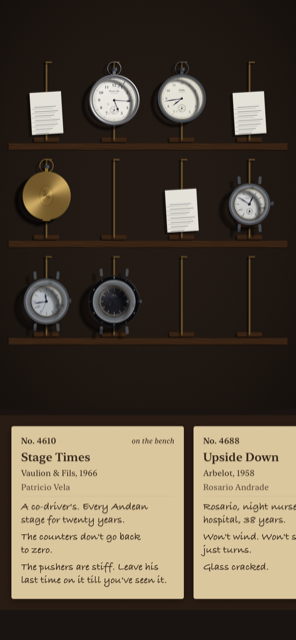
The workshop shelf: repaired pocket and wrist watches standing on brass stands, each running, with letters in place of the ones that went home, and the drawer of unopened envelopes below
THE SHELF — EVERY WATCH ON IT STILL RUNNING
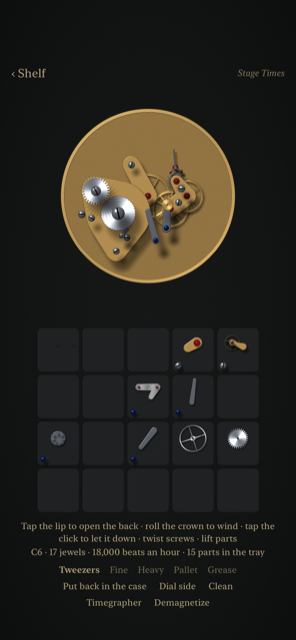
A chronograph movement half apart on the bench, its bridges lifted and lying in the numbered compartments of the parts tray below
THE BENCH
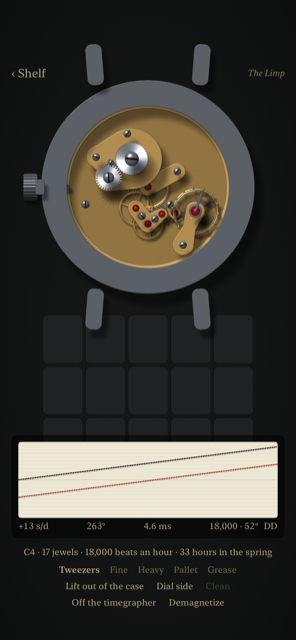
The timegrapher's paper trace: two lines of dots climbing across the paper, one for the ticks and one for the tocks, with the rate, amplitude and beat error read out below
THE TIMEGRAPHER
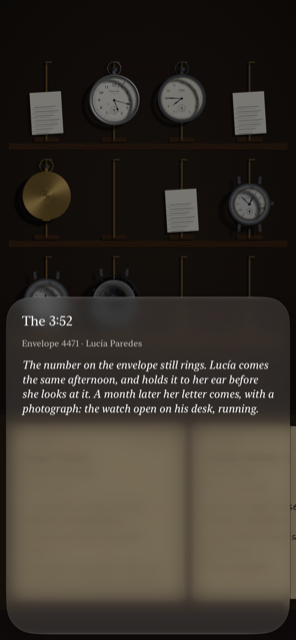
A letter on the shelf where a repaired watch used to stand, telling what happened when its owner came for it
WHAT CAME BACK

Nothing is faked

Every part is where a watchmaker would find it

The movements are not pictures of movements. Each caliber is laid out from its own tooth counts and pitch circles, and everything you can do to it follows from that geometry.

I

The train decides the beat

Barrel to centre to third to fourth to escape, each pair meshing at the sum of its pitch radii. Count the escape wheel's teeth, multiply by its turns an hour, double it for the two beats a tooth: that is where 18,000 an hour comes from, and the tick you hear is that number.

II

Parts cover each other by their real shapes

Nothing comes off in a scripted order. A part lifts when its own footprint and height leave it clear, so the balance comes off before the pallet cock and the ratchet before the barrel bridge — and when a part will not move, the game tells you which piece is holding it.

III

The fault is found by its symptom

A broken mainspring lets the crown turn and turn with nothing catching. A rusted click spring lets it spin back. A loose cannon pinion leaves the hands standing while the train runs. Old oil at the balance stops the watch face down and not face up.

IV

Oil goes on before the part that covers it

Each jewel takes the oil it takes — thin for the fast pivots, heavy for the slow ones, pallet stone oil on the exit stone, grease on the keyless works — and a drop you forget is a drop you will be taking a bridge off to reach.

V

The timegrapher is the escapement

Every dot on the trace is a beat the simulation actually made. A slope is a rate, a gap between the lines is a beat error, and a watch out of beat limps audibly before you ever put it on the machine.

VI

The shelf keeps running

A finished watch goes on its stand and keeps its own time from its own mainspring, running down after about a day and a half as it would. Pick one up, wind it, set it, open its back and look at the movement you rebuilt.
Six calibers, twelve watches

Each built to a real design

Not six skins on one movement. A pin-lever has no jewels and no centre wheel because that is what makes it cheap, and a full plate hides its train under one plate because that is what makes it a full plate.

A Swiss lever pocket movement

Fifteen jewels, small seconds at six, 1920s. Also in a hunter case with its train turned a quarter round, and at chronometer grade with a Breguet overcoil and a swan-neck regulator.

An American railroad full plate

Twenty-one jewels, lever-set so a knocked crown cannot move the hands, its nickel plates damaskeened, the balance above the plate where you can watch it.

A Roskopf pin-lever

No jewels at all, pins in the pallets instead of stones, and no centre wheel: the barrel is at the centre and drives the motion works off its own rim. Costs more to fix than to buy. Do it anyway.

A small wrist caliber

The 1940s workhorse, and with it a Soviet copy of the same design and a nurse's fob watch with indirect centre seconds, a pulsometer scale and its dial printed upside down.

A hi-beat automatic

36,000 an hour, a rotor on reversing wheels, day and date in English and Spanish, hacking seconds. Also as a 150-metre diver with a screw-down crown and a rotating bezel.

A column-wheel chronograph

Seven columns turning a step at every push, a coupling clutch swinging into mesh, a brake, and a hammer that drops on two heart cams to fly the hands back to zero.

Twelve envelopes

Somebody left each of these

Every envelope carries what the owner said and what Tomás wrote about it, in his hand. What is really wrong is not always what he wrote.

No. 4471 — The 3:52

Her grandfather's. It stopped the night he died, at 3:52. The crown turns and turns; nothing catches. She asks that you not move the hands.

No. 3308 — The Conductor

A railroad watch off the Quito–Guayaquil line. Gains minutes an hour. Kept on top of the radio, for the football.

No. T.A. — Tomás's Watch

His own apprenticeship watch, Neuchâtel 1961, left in pieces in a tray. The staff is gone. For whoever finishes this.

One purchase, and nothing to collect

Everything is in it: iPhone and iPad, all twelve watches, every free update. No advertising, no in-app purchases, no accounts, no analytics, and no networking code in the app at all. Your shelf follows you between your own devices through iCloud, which is yours and not ours.

Read the full Privacy Policy