← pablin.me

Tube-radio repair, on iPad

Mend it.
Tune it in. Put it back on the air.

In a radio shop in Quito's old town, across the street from Tomás Arroyo's watch shop, sixteen sets were left for repair and never collected. Each one is a real circuit, simulated as it runs, and each one has an owner's story that comes back when it plays again.

iPad iOS 17 US$4.99 once, no ads

Coming to the App Store.

No accounts, no analytics, and no network calls of its own
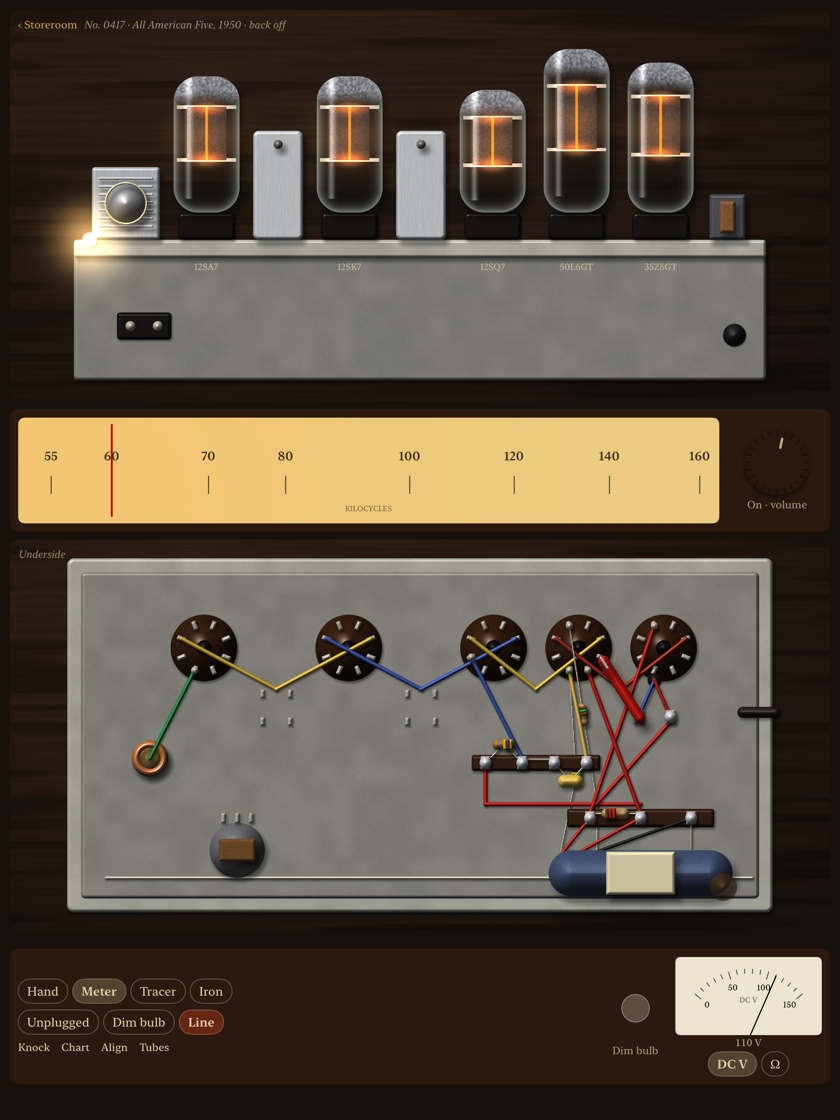
The bench: an All American Five from behind with its five tubes glowing orange, the dial below, the chassis turned over beside it with its point-to-point wiring, and the meter reading 110 volts on the output tube's plate
THE BENCH — FIVE TUBES WARM, 110 V ON THE PLATE
The shelf: eight restored radios on wooden planks and a console on the floor, one maroon table set with its dial lit
THE SHELF — ONE SWITCHED ON
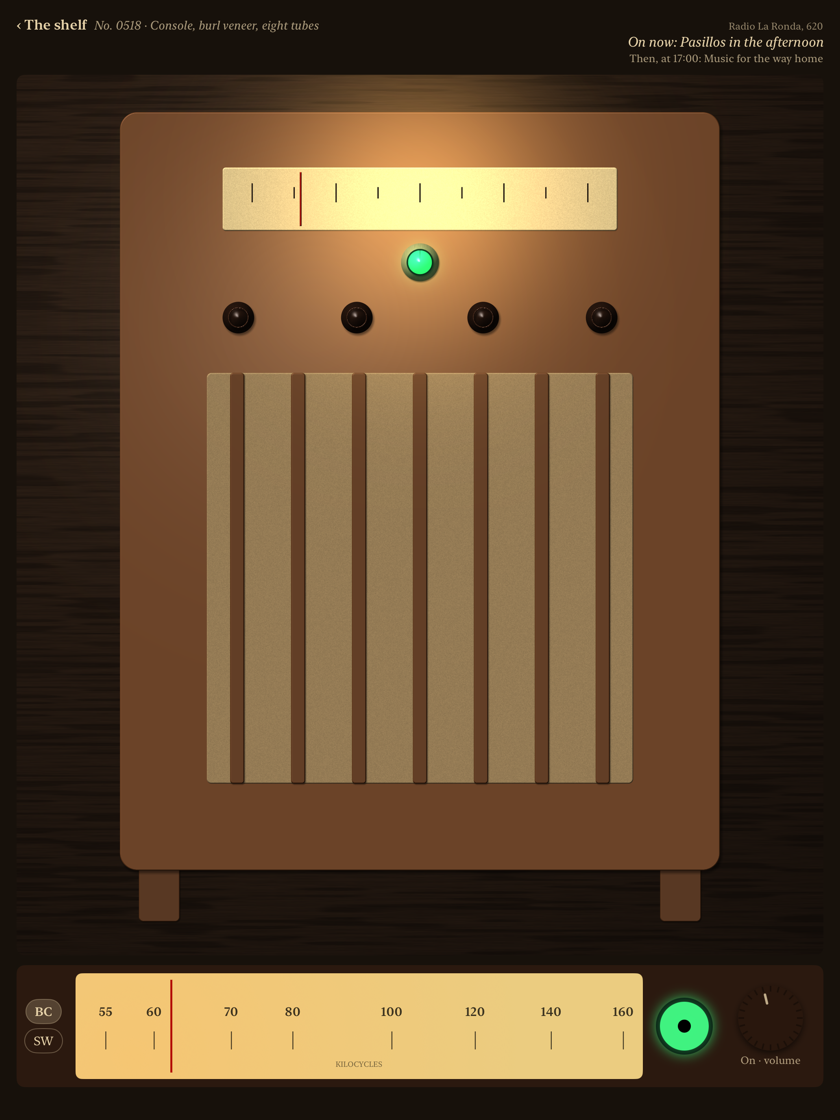
A 1939 console switched on: its dial glass lit, the pointer on 620, the green tuning eye closed on the station, and what Radio La Ronda has on now
RADIO LA RONDA, 620, BY YOUR CLOCK

Nothing is faked

Every set is its circuit, solved as it runs

The radios are not pictures of radios. Each chassis is its schematic, with real part values, and the game works out every voltage and every sound from it.

I

The tubes follow their data sheets

Each tube's curves are fitted through its data sheet's operating point. The voltages you read with the meter are solved from the whole circuit many times a mains cycle, not looked up, and a healthy set reads its service chart.

II

Faults are parts gone wrong

A dried filter capacitor is a smaller capacitor with more resistance, and the hum comes out of the ripple it lets through. A leaky coupling capacitor drags the output grid positive. Nothing is scripted, so two faults in one set combine as they would.

III

Warm-up is heat

The filaments glow up over seconds as they heat, cold tungsten a fraction of its hot resistance, and the sound fades in with the cathodes. A battery portable's filaments are on almost at once, as they were.

IV

A restorer's order of work

The dim-bulb tester first. The meter against the service chart. The signal tracer stage by stage until the signal stops. The iron, the parts drawer, the signal generator for the IF cans, the tube tester, and a knock on the chassis for the tube that rings.

V

The cabinet has its own craft

Wash first, and use the gentlest thing that works. Compound brings dull Bakelite back and takes the paint off an ivory set. A wet cloth lifts the numerals printed on the back of a dial glass. Harm shows the moment it starts, and it doesn't come back out.

VI

The station keeps its day

Switch on a set from the shelf and Radio La Ronda plays by your clock: the morning news, the pasillo hour at noon, the radionovela at seven, the match on Sunday afternoons. After dark, distant stations drift in on the sky wave.
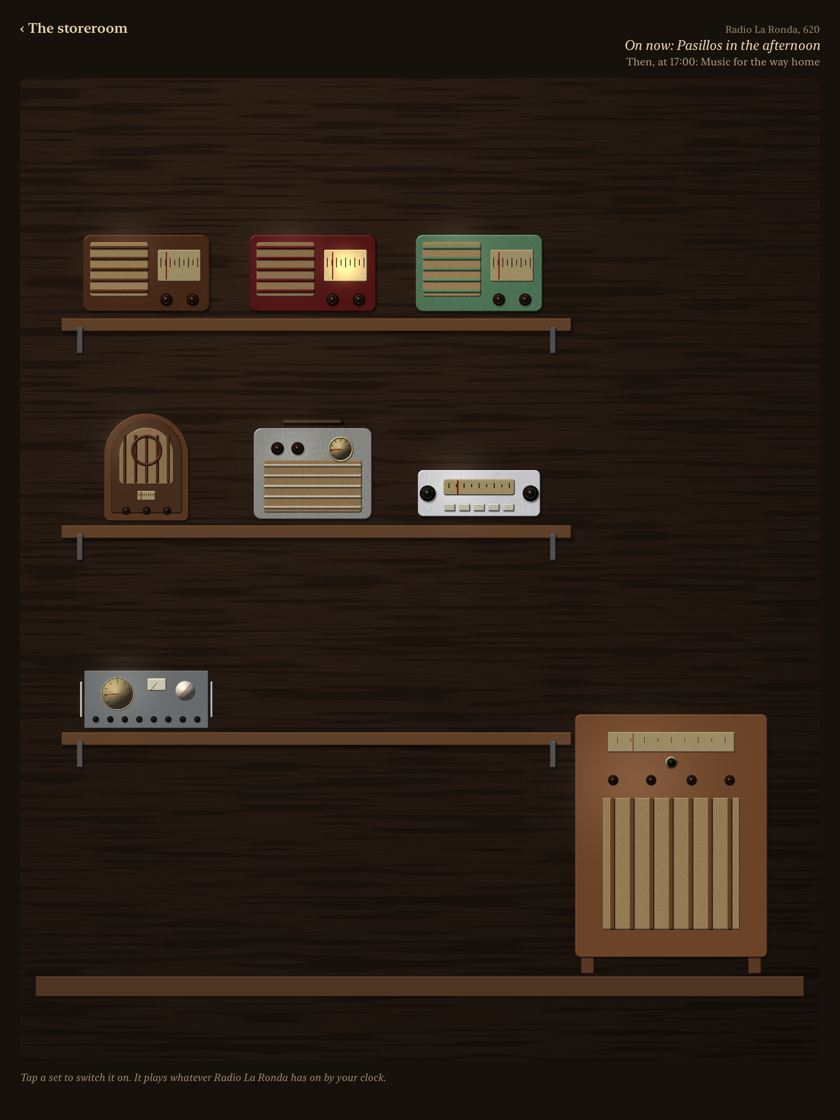
Six chassis, sixteen sets

Each built to a real design

Not six skins on one radio. A car set buzzes because its vibrator chops six volts into something a transformer can step up, and a cathedral's speaker is its own filter choke because that is how 1933 did it.

A 1950 table set

The All American Five: five tubes with their heaters in series across the mains, half-wave, its chassis wired to the line. Six of the sixteen tickets.

A 1933 cathedral

A power transformer, a full-wave rectifier and a field-coil speaker. Its 175 kHz IF brings strong stations in twice, the second time 350 kilocycles up the dial.

A 1939 console

Push-pull output, a green tuning eye that closes on a station, and a short-wave band behind a switch.

A 1949 battery portable

Filaments on a single cell and 90 volts from a B battery. Let the battery run down against a dried bypass capacitor and it motorboats.

A 1953 car radio

A buzzing vibrator, a gas rectifier, a buffer capacitor that has to stand a kilovolt spike, and a hash filter between the set and the car.

A 1946 communications receiver

A beat-frequency oscillator for Morse, a crystal filter with its phasing, an S-meter and bandspread.

Sixteen claim tickets

Somebody left each of these

Every set hangs from its ticket, with what its owner said was wrong. What they listened to, and why they stopped, comes when it plays.

No. 0417

“It hums like the refrigerator and then the music sinks under the hum. My husband listened to the Sunday matches on it.”

No. 0438

“Only a hiss. My nephew opened it and turned the little screws on top to help.” The Zambranos' set. Tomás Arroyo, across the street, has the conductor's watch that stood on top of it.

No. 0527

“It goes putt-putt-putt like a motorboat, and it rings if you touch the case.”

A game, not a repair guide

The sets in Back on the Air run at voltages that kill, and a table set's chassis is wired to the mains. The circuits are real and the procedures are shown as a restorer follows them, but nothing here is instruction for working on a real radio. If you have one, take it to someone who restores them.

One purchase, and nothing to collect

Everything is in it: all sixteen sets and every free update. No advertising, no in-app purchases, no accounts, no analytics, and no networking code in the app at all. Your shelf follows you between your iPads through iCloud, which is yours and not ours.

Read the full Privacy Policy

Back on the Air

Sixteen sets, six chassis, one storeroom. US$4.99 once — every set, every update, nothing else to buy.

Coming to the App Store.

iPad · iOS 17